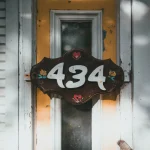
First impressions are formed at the front gate. Long before visitors reach your door, they have taken in the path, the plants, the lighting and whether they could actually find your house number from the street. The wonderful thing about front entrance garden ideas is how far a modest budget stretches: a few well-chosen plants, a couple of lights and a smart house number sign can transform a forgettable frontage into the best-looking entry on the street. Here is a practical, step-by-step kerb appeal project designed for Australian homes, achievable over two or three weekends.
Step 1: Audit Your Entrance From the Street
Start with a walk to the kerb, then turn around and look at your home the way a first-time visitor would. Take a photo; the camera is brutally honest. Ask yourself a few questions. Can you read the house number from a car at night? Does the path lead the eye naturally to the front door? Is there anything green and alive, or just bins and a hose? Is the lighting welcoming, non-existent, or a single glaring floodlight? Jot down the three things that bother you most. Those three become your project plan, and almost always they fall into the same categories: plants, lighting and identification.
Step 2: Front Entrance Garden Ideas That Frame the Door
Entrance planting has one job: to guide people to the door and make the journey pleasant. That means structure first, softness second.
Structure Plants
Symmetry flatters a front entrance. A matched pair of pots either side of the door, planted with clipped coastal rosemary (Westringia fruticosa), dwarf lilly pilly or a neat cycad, instantly signals care. Good-sized glazed pots run $60 to $150 each at hardware chains, and the westringias about $15 apiece. Along the path, repeat a single low plant, such as Lomandra ‘Tanika’ or dwarf agapanthus, every metre or so. Repetition reads as design, even when the budget is small.
Softness and Colour
Between your structural plants, add seasonal colour and scent near the door where it will be appreciated: star jasmine climbing a porch post (magnificent in November), a gardenia or native frangipani for summer fragrance in warm areas, or salvias and seaside daisies for months of easy flowers. In frost-prone towns, swap in correas, hellebores and lavender. Keep the palette to two or three colours plus green; restraint is what separates a designed entrance from a jumble.
Practical Considerations
Choose plants that stay below window height near the facade, keep anything spiky well back from the path, and favour drought-hardy species so the entrance still looks good in February. Mulch every bed with the same material for visual calm. If your path itself needs work, our guide to DIY garden path ideas on a budget covers gravel, pavers and brick options that pair perfectly with this project.
Step 3: Lighting That Welcomes and Protects
Lighting is the cheapest drama you can buy for a front garden, and modern solar options mean no electrician is required for most of it.
- Path lights: Solar bollards from $15 to $40 each, spaced every 1.5 to 2 metres along one side of the path only. Lighting both sides creates an airport runway effect.
- A feature uplight: One spike spotlight ($25 to $60) angled into a small tree or your best pot adds instant depth and shadow play.
- Door lighting: A warm wall light either side of the door, or a single pendant under a porch, beats a bare bulb every time. Choose warm white (2700K to 3000K) everywhere; cool white light makes gardens look like carparks.
- Sensor security: Keep the motion floodlight if you like, but aim it down the driveway, not at arriving guests.
Budget $100 to $250 covers a full solar lighting scheme for an average frontage. If you want hardwired quality later, run the solar version first for a season to learn where light actually earns its keep.
Step 4: House Numbers People Can Actually Find
Here is the detail most makeovers forget: identification. Delivery drivers, dinner guests and, importantly, emergency services all need to find your number fast, day or night. A tiny brass numeral screwed beside the door in 1987 no longer cuts it.
Modern floating aluminium or stainless numerals, in sizes from 15 to 30 centimetres, are readable from the street and look sharp against render, timber or a letterbox pillar. Mount them at eye height where they are visible from both directions of approach, with contrast doing the heavy lifting: light numbers on dark backgrounds and vice versa. Position a path light or small spotlight so the number stays legible after dark. We covered styles, sizes and placement in detail in our earlier post on house numbers to make your property pop, and it remains one of the highest-impact upgrades per dollar on this entire project list.
Step 5: The Finishing Layer
With plants, lighting and numbers sorted, the last weekend is about polish. Oil or repaint the front door in a confident colour; a litre of exterior paint costs about $40 and a deep green, navy or classic red door against a neutral facade is the single most photographed kerb appeal trick for good reason. Replace a tired doormat, hide the bins behind a simple timber or bamboo screen ($50 to $120), and add one personal flourish: a ceramic pot with sculptural foliage, a hanging basket, or a small piece of outdoor art. Our post on garden art and decor has plenty of ideas for that final personal touch that makes an entrance yours rather than a display home’s.
Do Not Forget the Letterbox and the Verge
The entrance experience starts at the footpath, not the front door. A leaning, rusted letterbox undoes all your good work, so straighten it, repaint it, or replace it; a smart pillar-mounted or timber box runs $60 to $200 and takes an hour to install. If your number sign lives on the letterbox, make sure it matches the style of the numerals on the house for a coordinated look.
The verge or nature strip matters too. Keep it mown and edged at minimum, and if your council permits verge gardens (many now encourage them), a strip of lomandra and myoporum groundcover turns dead grass into an extension of your frontage that never needs mowing again. Check your local council’s verge planting guidelines first, as most have simple rules about sightlines and plant heights near driveways. It is a small weekend job that quietly doubles the width of your garden as seen from the street.
Budget Summary and Timeline
- Weekend one, planting: Pots, structure plants, colour and mulch, roughly $250 to $450.
- Weekend two, lighting and numbers: Solar scheme plus quality numerals, roughly $180 to $400.
- Weekend three, polish: Door paint, screening and decor, roughly $100 to $250.
All up, somewhere between $500 and $1,100 buys a complete front entrance makeover that would cost several thousand dollars done professionally, and every part of it is beginner-friendly. Spring and autumn are the kindest seasons for the planting stage, giving new shrubs mild weather to settle in.
Upkeep from there is a pleasant fifteen minutes a fortnight: deadhead the seasonal colour, sweep the path, wipe the number sign, and give the pots a deep drink in summer. An entrance stays impressive not because it was expensive, but because it is clearly looked after, and small regular attention beats an annual blitz every time.
Real estate agents consistently rank street presentation among the highest-return improvements a home can make, and buyers form their opinion of a property within seconds of pulling up. But the best part is how the project keeps paying you back. You will feel it every evening you walk up a softly lit path past plants you chose, to a door that looks like it belongs to people who love their home. That daily welcome, as much as any valuation boost, is what kerb appeal is really for.